Tribute to Claude Monet – St. Radegonde Church in Giverny
William Amor — A Tribute to Claude Monet
Sainte-Radegonde Church in Giverny
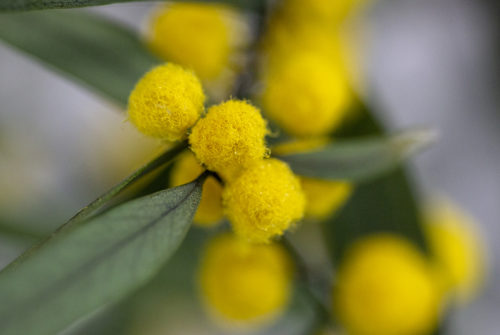
In Giverny, flowers were much more than just a subject for Claude Monet’s paintings:they were a laboratory of light, a living language capable of conveying the seasons, the hours of the day, and the movements of the soul.
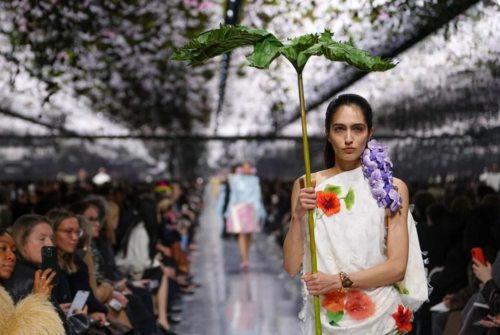
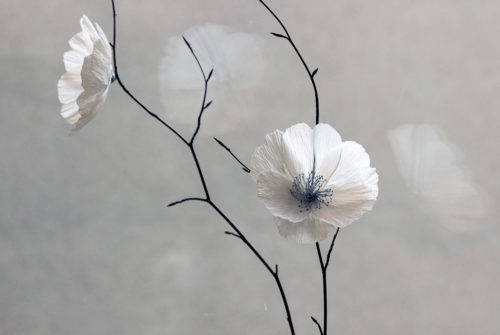
To pay tribute to this legacy, William Amor brings into the church the colors of the garden that has vanished behind the stone walls. Where Monet observed the transformations of living things, the contemporary artist reveals those of matter. Discarded and then collected, plastic bags, bottles, and fragments of consumer goods are transformed with the patience of a jeweler into petals, corollas, foliage, and flashes of light.
A century separates Claude Monet and William Amor, yet they seem to share the same conviction: beauty is not found in things themselves, but in the way we look at them. Monet revealed the infinite variations of light in a pond, a sky, or a flower. William Amor reveals the unsuspected poetry of materials that our era considers worthless. Both invite us to see the world in a different light.
Through four installations corresponding to the seasons, William Amor creates a sensory journey inspired by the world of the Impressionist master. The works do not seek to reproduce Monet’s paintings; rather, they extend his spirit. Just as the Impressionist brushstroke made color vibrate to capture the moment, these fragments of recycled material come together to give rise to a new poetry of the gaze.
From the vibrant spring of the flower-adorned arches to the contemplative winter of the water gardens, visitors are invited to journey through a cycle where nature, art, and memory intertwine. A celebration of the beauty of life, but also an invitation to see in a new light what our society deems ordinary, useless, or neglected.
For in William Amor’s work, every material holds within it the possibility of rebirth.

LA NEF AUX ARCHES FLEURIES — SPRING
Beneath the church’s vaulted ceiling, a hanging display of flowers evokes the famous arches of roses that guided visitors through Claude Monet’s garden.
Hundreds of flowers crafted from plastic bags collected and transformed by the artist form an ethereal pathway where reds, pinks, and fuchsias burst forth like a botanical fireworks display.
Bathed in light that evokes the shifting reflections of Impressionism, the installation celebrates spring as a season of vitality, blossoming, and promise.
Materials: plastic bags, reinforced wire, light installation.
Crédits photo Marco Strullu
LE BASSIN — IMPRESSION DE NYMPHÉAS— SUMMER
Crédits photo Marco Strullu
180 cm x 180 cm
With his Water Lilies, Claude Monet transformed the pond at Giverny into one of the most iconic landscapes in art history. Here, William Amor offers a contemporary reinterpretation of it.
On the floor, a mosaic of translucent plastic fragments forms a vibrant surface where light seems to reflect as it would on water. Water lilies emerge from this constellation of colors, suspended between painting and sculpture. Scrap becomes pigment; waste becomes shards.
The work evokes summer, when the garden reaches its full maturity and the eye is lost in the endless interplay of light and reflections.
Materials: fragments of plastic bottles, brass, wooden frame.
LA COUPOLE AU LUSTRE VÉGÉTAL VITRAIL — FALL
Crédits photo Marco Strullu
180 cm x 180 cm
Suspended beneath the dome, a cascade of 135 vines of translucent petals descends from the church ceiling like a silent shower of colors. Amid the golds, greens, and the reflections of the stained-glass windows, shades of pink emerge—a distant echo of the flower-adorned arches that welcome visitors as they enter this imaginary garden.
Inspired by both the stained-glass windows of Sainte-Radegonde and the weeping willows that populate Monet’s landscapes, the installation transforms the space into a vast, plant-based chandelier. Each element captures and diffuses light, revealing delicate shades that evoke the chromatic vibrations of Impressionist painting.
Autumn is expressed here as a time of transformation: a time when light becomes more precious, and colors deepen before fading away.
Materials: plastic bottles and bags, string, suspended metal frame.
CÉRÉMONIE DANS LES JARDINS D'EAU — WINTER
Crédits photo Marco Strullu
To conclude this journey, William Amor draws inspiration from an episode related to Claude Monet’s funeral. Refusing to wear the black of mourning, his friend Georges Clemenceau had his friend’s coffin draped in a fabric featuring the colors of the flowers in the garden.
Surrounding the hearse preserved in the church, the artist has created an abstract water garden composed of scraps and fragments from his own creations. Echoing this historic gesture, a white cloth embroidered with blue flowers—evoking the hydrangeas emblematic of his artistic world—softens the dark veil that now covers the hearse.
Here, the material appears almost in its original state, as if the cycle of metamorphosis were returning to its source. Winter thus becomes not an end, but a time of remembrance and rebirth. Beneath the simplicity of the gesture, the coming spring is already beginning to emerge.
Materials: plastic scraps from the artist’s studios, embroidered fabric, site-specific installation.
PROJECT TEAM
William Amor, Valérie Henry, Rémy Jarnoux et Marion Le Bellec.
Date:
5 October 2026