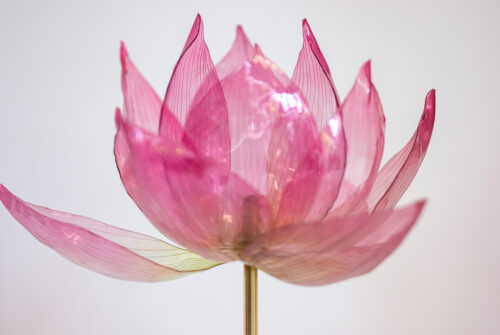
‘Gunnera Leaf’ de William Amor pour DIOR Haute Couture SS 2026 by Jonathan Anderson – Paris
There is something about this unfurled leaf that evokes a primal shelter.
An architecture of coolness, a leafy canopy open to the world above.
The entire structure – stem, ribs, capillary network – was created from brass. Salvaged brass, collected in 2023 when the Weber Métaux company closed, in the 3ᵉ arrondissement of Paris, mixed with fragments of William Amor’s former projects. This metal, once utilitarian, here becomes sensitive matter. Under the hand, it is chiseled, worked with a goldsmith’s meticulousness: each rib is engraved, stretched, branched with such precision that it seems to have grown naturally. Silver brazing unites these fragments into a living skeleton, then polishing reveals a metallic skin where light circulates like sap.
Color emerges on this exquisite framework.
Painted and weathered with a brush, the metal’s surface takes on subtle shades, becomes muted, and takes on a warm glow. Subtle, almost organic gradients emerge—from deep green to the muted reds of the stem—creating the unsettling illusion of a plant more lifelike than nature itself, as if the metal remembered having once been a leaf.
The rest of the panel stems from another rescue: that of the tarlatan.
These textile fragments, recovered in 2020 from the workshops of René Tazé, an intaglio art printer, already carry within them a memory of ink and craftsmanship. Here, they are transformed. Dyed in a bath, impregnated with pigments, and enhanced by a colored coating, they become surface, flesh, and breath.
Twenty-six patterns were cut, adjusted and applied with almost anatomical precision to each rib intersection, like so many recomposed cells.
The edge of the leaf, on the other hand, is a labor of extreme patience:
frayed thread by thread, stretched with tweezers, then dyed in vibrant reds.
In this way, it recreates the irregular, crenellated lace of the Gunnera—that living fringe that captures light and air.
Hot-iron embossing then imprints the fabric with the furrows, the relief, and the unique texture of this plant: an almost animal-like skin, known as “toadskin,” where the material seems to quiver.
Finally, the thorns —supple and translucent—made of extruded silicone, appear, applied one by one with a syringe. Tinted red, they dot the surface, echoing the chromatic contrasts of the stem and the edges.
They serve as both defense and ornament, detail and signature.
Recomposed in this way, the Gunnera leaf becomes more than a reproduction. It is a transmutation. An object of passage, where waste becomes precious, where industrial and artisanal memory merge into a plant-based imagination.
Under this haute couture umbrella, the artist doesn’t copy nature: he extends it.
At the crossroads of naturalist, goldsmith and chemist, William Amor fashions a body of work in which each gesture repairs, assembles and reveals.
And within this ornamental leaf—offered as a refuge—a silent promise endures:
that of a beauty born of metamorphosis, fragile yet majestic.

Photo credit ©Dior – 2026
In January 2026, at the Musée Rodin, Jonathan Anderson presents his first Haute Couture show for DIOR. A show imagined by the house’s new artistic director as a bucolic, poetic stroll through an English garden.
For this collection, DIOR asked visual artist William to create an ultra-realistic giant leaf sculpture of Gunnera in his signature style. For the show, the sculpture was worn like a romantic parasol.
The sculpture took around 400 hours to complete.
- 150 hours to create the leaf structure, stem and entire rib network in brass.
- It took 250 hours to assemble the piece, assembling materials, textures and cosmetics.
- 50 hours for detailing and finishing.
PROJECT TEAM
William Amor, Valérie Henry, Rémy Jarnoux et Marion Le Bellec.