

Les Créations Messagères
ActualitéWilliam Amor, Portrait | The New York Times
2026.11.19NYT-cover Wiliam Amor ©Dimitry Kostyukov

William Amor, Portrait | The New York Times

His Blooms Are Not What You Would Expect

William Amor uses discards such as plastic bottles and cigarette butts to create faux roses, irises and other blossoms.

By Felicia Craddock
Reporting from Paris
Nov. 19, 2026

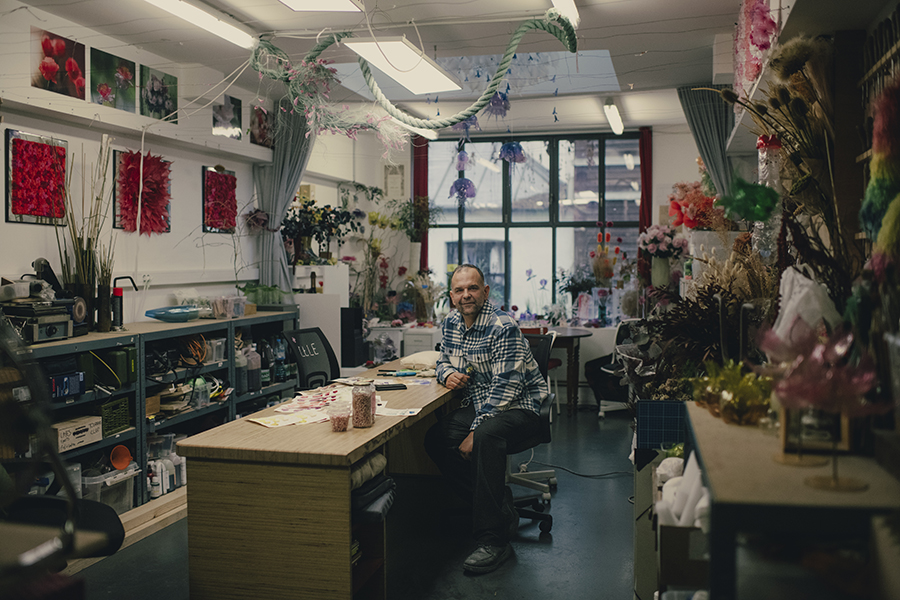
French artist William Amor, 46, at his studio in Paris on November 10, 2026. Dmitry Kostyukov for The New York Times

Mr. Amor at his studio in Paris. “In the end, all this poetry, it’s a tribute to living things,” he said of his work.
Dmitry Kostyukov for The New York Times

When William Amor arrived in the French capital in 2000, he found he was starved for nature.
“I never got used to Paris,” said Mr. Amor, 46, seated at the long work table that runs through the center of his galley-like workshop, called Les Créations Messagères, or Creations With a Message, in the 10th Arrondissement.

“From the moment I arrived, I dreamed of having a garden.”
“Then again,” he added, “it’s thanks to that lack that this garden was born.” He was looking at the armloads of what appeared to be dusty pink roses, slender-stemmed irises, cherry blossom branches and showers of translucent petals and vines that crowded his studio’s large light-filled window. The blooms all had one thing in common: They were created from discarded items such as plastic bottles, washed-up fishing nets, cigarette butts, coffee pods and aluminum cans.

In nature, “everything serves a purpose,” Mr. Amor said. “And when a gaze is cast differently, magnificent things can bloom.”

Mr. Amor grew up in the Lorraine region of northeastern France. He recalled that at 8 years old, already fully versed in the botanical nomenclature of plants and requesting bulbs for Christmas, he “dreamed of being a botanist.”

In 1998, he began studying for a degree in plant biology and genetics at what is now the University of Lorraine.

His aspiration: to create a hybrid as beautiful as the Catherine Deneuve rose, an orangy-pink bloom that the French breeder Meilland named for the French actress in 1981.

The reality:

We were dissecting frogs,

he said.

A Red Plastic Bag

After two years he abandoned his degree and left for Paris, taking on a string of jobs that led to work at a fashion communications agency and, finally, striking out on his own to represent artists and social projects. But then he came across a red plastic bag in the street. Mr. Amor recalled being struck by its beauty: “Its transparency made me think of a flower petal.”

He brought it home and with scissors began crafting a simple poppy, using a lighter to melt the ends of fishing net fibers to create its stamens. From then on, he said, “I started looking at all the waste surrounding me in a different way.’’
Mr. Amor said he had taught himself the various skills he needed. “My work is the result of around 20 years of artistic experimentation of all kinds,” he said. “I was also
very interested in the artistic techniques mentioned in art and fine crafts books. From this information, I experiment and create my own techniques, which I constantly evolve, improve and refine.”

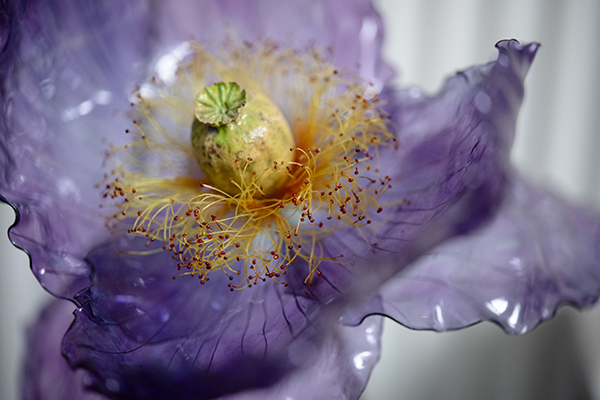
Details of the artificial flowers made from discarded materials, including plastic bottles, ropes and cigarette butts, by French artist William Amor, 46, at his studio in Paris on November 10, 2026. Dmitry Kostyukov for The New York Times

The plastic or other material Mr. Amor might use is given texture — embossed, veined, frosted, crimped, sculpted or pleated — often using centuries-old techniques.

Dmitry Kostyukov for The New York Times

Crédit-vogue Runway _Balenciaga-24 réalisation des 7000 plumes upcycling en sacs plastique

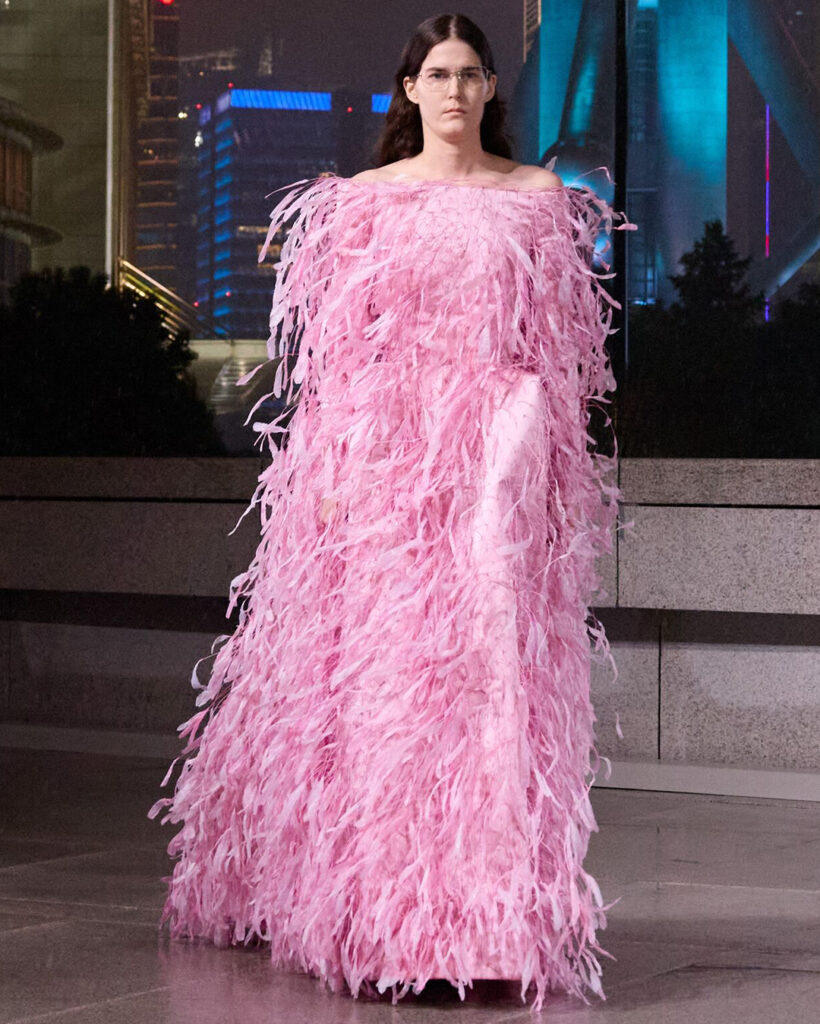
A faux-feather dress that closed Balenciaga’s cruise show in 2024, made from 250 plastic bags.

Balenciaga

In 2015, Mr. Amor founded his company and presented its first installation: “La Déchetterie, Fleuriste de Luxe,” or “The Dump, Luxury Florist.” The display, at an eco- fashion store in Paris’s Marais neighborhood that has since closed, was staged to resemble a flower seller’s counter.

Subsequent creations have included a blossoming egg sculpture — made of papier- mâché created from tax forms and encased in a mosaic of cigarette filters — for Galerie Joseph’s spring 2026 Eggxtraordinaire exhibition in Paris.

And there was the pink faux-feather plastic dress that closed Balenciaga’s cruise fashion show in May 2024 in Shanghai.

(It took 11 people a month to make the 7,000 faux egret feathers from 250 plastic bags, said Mr. Amor, who hires assistants on a project-by-project basis.)

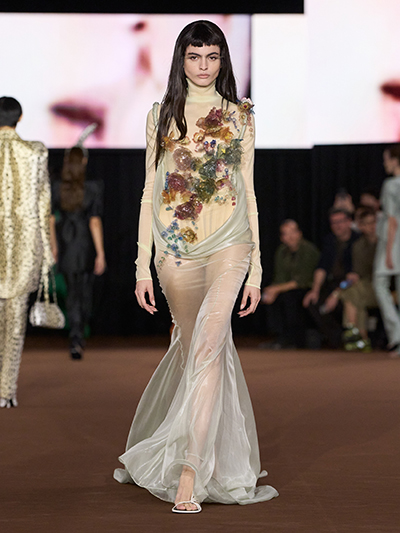
During Paris Fashion Week in October, Mr. Amor’s bouquet of plastic-bottle irises, roses, lily of the valley, wisteria and anemones appeared to be appliquéd onto a sheer gray-green dress in Mugler’s spring 2027 runway show.

It originally was intended for the back of the gown, Miguel Castro Freitas, Mugler’s creative director, wrote in an email. But, “I was so taken by the craftsmanship that I wanted to bring the flowers to the front,” he said. “William has a remarkable ability to find beauty in what others might overlook or reject.”

Credit MUGLER SS 27 by Miguel Castro Freitas Photo: Alessandro Lucioni / Gorunway.com

A creation by Mr. Amor for the Mugler spring 2027 collection, shown during Paris Fashion Week in October.

Estrop/Getty Images

Centuries-Old Techniques

Mr. Amor has always considered his materials precious — for example, petroleum, the foundation of many discarded products, comes from a finite fossil resource that took millions of years to form, he said — but transforming them is both labor-intensive and messy.
To prepare the plastic for Balenciaga’s egret feathers, the bags first were cleaned and stripped of their logos. “It’s pretty horrible because we’re forced to use thinners, so we wear gas masks,” Mr. Amor said.
The bags were then submerged in a bath of boiling water and pigments, and salt was later added to set the colors. “I rinse them in a basin of clean water because I am very mindful of water consumption and of designing a nonpolluting process,” he said.
“Afterwards, they are air-dried.”

Once colored, the plastic or other material he might be using for a particular project is given texture — embossed, veined, frosted, crimped, sculpted or pleated — often using centuries-old techniques including embroidery, marquetry, feather work and flower making. (In traditional haute couture, the art of fabric flower making is called parurier florale, and is also practiced by luxury supply houses such as Lemarié and Legeron.)

As for Mr. Amor, “he brings together a lot of crafts,” said Raphaëlle Le Baud, the author of “Petit Éloge des Métiers d’Art,” a book about fine craftsmanship, referring to the selection of 19th-century flower ornament-making tools, including embossing and shaping irons, that hang on a wall in Mr. Amor’s workshop.
Using such know-how with completely new materials, his creations are “really where the past and future meet,” she said.

Nothing Wasted

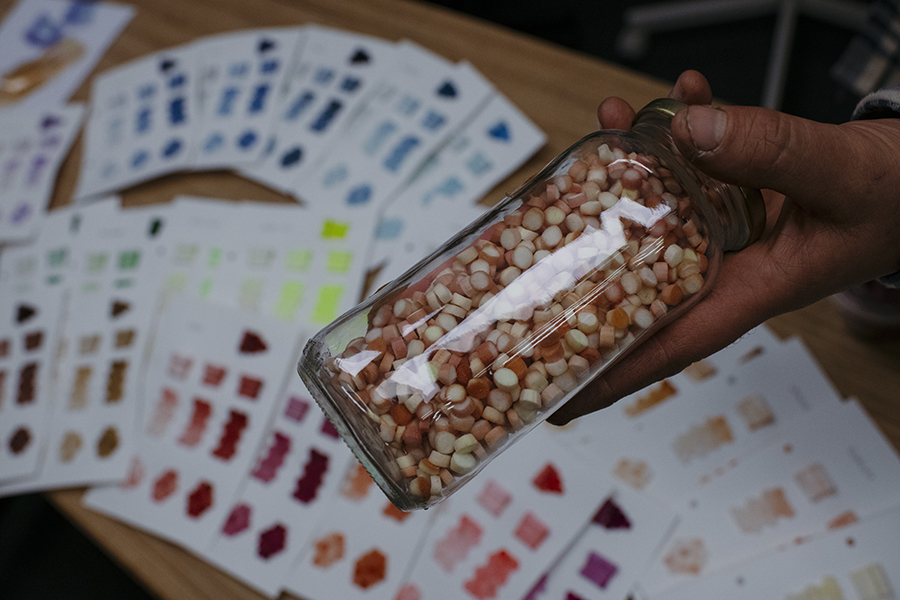
A palette of cigarette butts painted in various colors by French artist William Amor, 46, at his studio in Paris on November 10, 2026. Dmitry Kostyukov for The New York Times

Discarded cigarette butts painted in various colors.
Dmitry Kostyukov for The New York Times

Having spent two decades perfecting his methods, Mr. Amor declined to be more specific about his process. But he did note that “it’s always very different,” drawing on materials that range from large cooking-oil containers to wig trimmings from the Crazy Horse cabaret in Paris. He stores all his supplies, meticulously itemized, in four units, each about 11 square meters (almost 120 square feet), in the city.

His one core tenet: Nothing is wasted. “I keep everything, even brass dust,” he said, noting with satisfaction that his collection of dye-soaked paper towels became the stems and leaves of rose brooches seen in Balenciaga’s fall 2025 couture collection, its final couture show from the designer Demna.

And Mr. Amor assembled his trove when he was given carte blanche to create theartwork for “Homage to Claude Monet,” an exhibition at Église Sainte-Radegonde, thechurch in Giverny, France, where the artist was buried 100 years ago. (Through Dec. 5; admission is free.)
To create the pastel-hued water for one piece, “Summer: Impression of Water LilliesPond,” he cut rectangles from some off-cuts of plastic bottles that he had collected overthe past 15 years. Each piece was curled using a flame and then arranged to resemblebrushstrokes.

The effect “is quite incredible,” said Ludivine Ponte, the director of culture andheritage for the Normandy department of Eure, who oversaw the exhibition.

Givingthe impression of water moving, the interplay of light through the material makes itfeel almost alive, she said.

Mr. Amor said the exhibition was one of his projects that had pleased him most.Referring to the artist’s famous garden in Giverny, he said Monet “made his livingcanvas to get inspiration, and that resembles me so much.” He recently purchased landin the Perche region, about 100 miles southwest of Paris, where he plans to build alarger workshop and to grow plants.

“In the end, all this poetry, it’s a tribute to living things,” Mr. Amor said, looking onceagain at the floral display filling his atelier window. “Now that I have a garden, I’vealready placed orders for 4,000 bulbs.”


By Felicia Craddock

William Amor, trouve l’origine de sa démarche artistique dans une volonté de mettre l’art au service de la poésie, du vivant et de l’écologie. Avec ses œuvres singulières, sensibles et porteuses de sens, l’artiste propose un autre regard sur tout ce qui nous entoure et ce dont nous avons oublié ou dénigré la présence, l’existence et l’origine.